Why Judicial Diversity Matters: Representation and Legitimacy in the UK
Judicial diversity refers to the principle of ensuring that the judiciary consists of members who represent the demographic characteristics of the population it serves. This includes, but is not limited to, age, gender, sexual orientation, and socioeconomic background [1]. It is widely believed to serve as a critical mechanism for ensuring justice [2]. This essay examines how judicial diversity influences human rights across common law jurisdictions and considers mechanisms through which diverse judicial bodies strengthen individual liberties..
Judicial diversity brings different life experiences to the bench, allowing judges to recognise and address inequalities that homogenous judges could easily overlook [3]. A diverse bench enables more effective identification of discriminatory patterns and more inclusive interpretation of rights, supporting minority groups [4]. This is particularly significant in human rights adjudication, where sensitivity to bias and vulnerability is essential for justice.
In cases such as A v Chief Constable of the West Yorkshire Police (2004), judicial awareness brought by the Judicial Appointments Commission's emphasis on diversity, influenced more protective jurisprudence [5]. Judicial diversity improves the legitimacy of decisions on human rights, a fundamental for effective legal systems. Public confidence in the fairness of judicial decisions increases, when members of the community see themselves reflected on the bench [6].
The UK judiciary has suffered from exclusivity and homogeneity for a long time. However, increasing diversity has demonstrably improved public trust. The appointment of judges from underrepresented backgrounds has strengthened confidence in the judiciary among all, especially minority communities. For instance, the appointment of the first Muslim judge to the High Court, Justice Rabinder Singh, has shown institutional commitment to inclusivity and enhanced legitimacy among the Muslim population [7], which constitutes approximately 6% of UK citizens [8]. Furthermore, diverse judiciary has contributed to more culturally sensitive judgments in cases regarding religious freedom. For example, in R (Begum) v Secretary of State for the Home Department (2021), diverse judicial perspectives strengthened the criticism of the government discriminating vulnerable populations, reinforcing public confidence that everyone has a right to a fair hearing [9].
Some critics argue that prioritising diversity might undermine the quality of judicial decision-making [10]. Additionally, diversity alone cannot solve the problem of deficiencies in access to a fair trial and justice. However, evidence suggests that diverse decision-making bodies produce better outcomes [11]. The UK has shown that the attempts to enhance diversity and selection processes do not exclude one another; rigorous selection processes still stand alongside targets for diversity and inclusion. Finally, while diversity alone cannot solve all systemic injustices, it makes sure the application of law reflects an understanding of those marginalised.
One of the most important ways to guarantee that human rights are upheld in common law jurisdictions is through judicial diversity. Diverse judiciaries enhance awareness of systemic discrimination and guarantee that justice systems benefit all by bringing a range of viewpoints and experiences to the bench. The experience of the UK shows that diversity initiatives result in quantifiable improvements in public trust in the judiciary. Judicial diversity must remain a top priority for the UK and similar jurisdictions going forward, as it is both a matter of justice and a practical requirement for efficient human rights protection.
References
[1] ‘House of Lords - Judicial Appointments - Constitution Committee’ (UK Parliament, 7 March 1012 <https://publications.parliament.uk/pa/ld201012/ldselect/ldconst/272/27206.htm> accessed 10 November 2025
[2] Rackley E, ‘Short History of Judicial Diversity’ (Oxford Academic, 9 August 2023 <https://academic.oup.com/clp/article/76/1/265/7239481> accessed 10 November 2025
[3] ‘Lady Chief Justice: Diversity and Inclusion Statement’ (Courts and Tribunals Judiciary, 13 November 2024)<https://www.judiciary.uk/about-the-judiciary/diversity/message-from-lcj-judicial-diversity/> accessed 11 November 2025
[4] (Judicial diversity in common law jurisdictions outside of England and Wales, 2022)<https://judicialappointments.gov.uk/wp-content/uploads/2022/10/ANNEX-B-International-judicial-diversity-REA_FINAL-Aug-2022_V1-002.pdf> accessed 11 November 2025
[5] (House of Lords - A (Respondent) v Chief Constable of West Yorkshire Police (Appellant), 2004) <https://publications.parliament.uk/pa/ld200304/ldjudgmt/jd040506/chief-1.htm> accessed 11 November 2025
[6] Barton-Crosby J, ‘Judicial Diversity: Barriers and Initiatives’ (National Centre for Social Research, 2023)<https://natcen.ac.uk/sites/default/files/2023-02/Judicial diversity_barriers & initiatives report_0.pdf> accessed 11 November 2025
[7] Fouzder2016-10-27T12:27:00+01:00 M, ‘Look on Bright Side of Diversity, Says Sikh Top Judge’ (Law Gazette, 27 October 2016) <https://www.lawgazette.co.uk/law/look-on-bright-side-of-diversity-says-sikh-top-judge/5058536.article> accessed 11 November 2025
[8] ‘British Muslims in Numbers: Census Report Summary 2025’ (Muslim Council of Britain, 7 April 2025)<https://mcb.org.uk/resources/censussummary2025/> accessed 11 November 2025
[9] ‘Begum (Respondent) v Secretary of State for the Home Department (Appellant)’ (UK Supreme Court, 6 February 2025) <https://www.supremecourt.uk/cases/uksc-2020-0158> accessed 11 November 2025
[10] MacLeod J, ‘Resistance to Diversity among Judges Is Misguided | Jennifer Macleod’ (The Guardian, 3 November 2011) <https://www.theguardian.com/law/2011/nov/03/resistance-diversity-judges-misguided> accessed 11 November 2025
[11] Larson E, ‘New Research: Diversity + Inclusion = Better Decision Making at Work’ (Forbes, 12 October 2022) <https://www.forbes.com/sites/eriklarson/2017/09/21/new-research-diversity-inclusion-better-decision-making-at-work/> accessed 11 November 2025
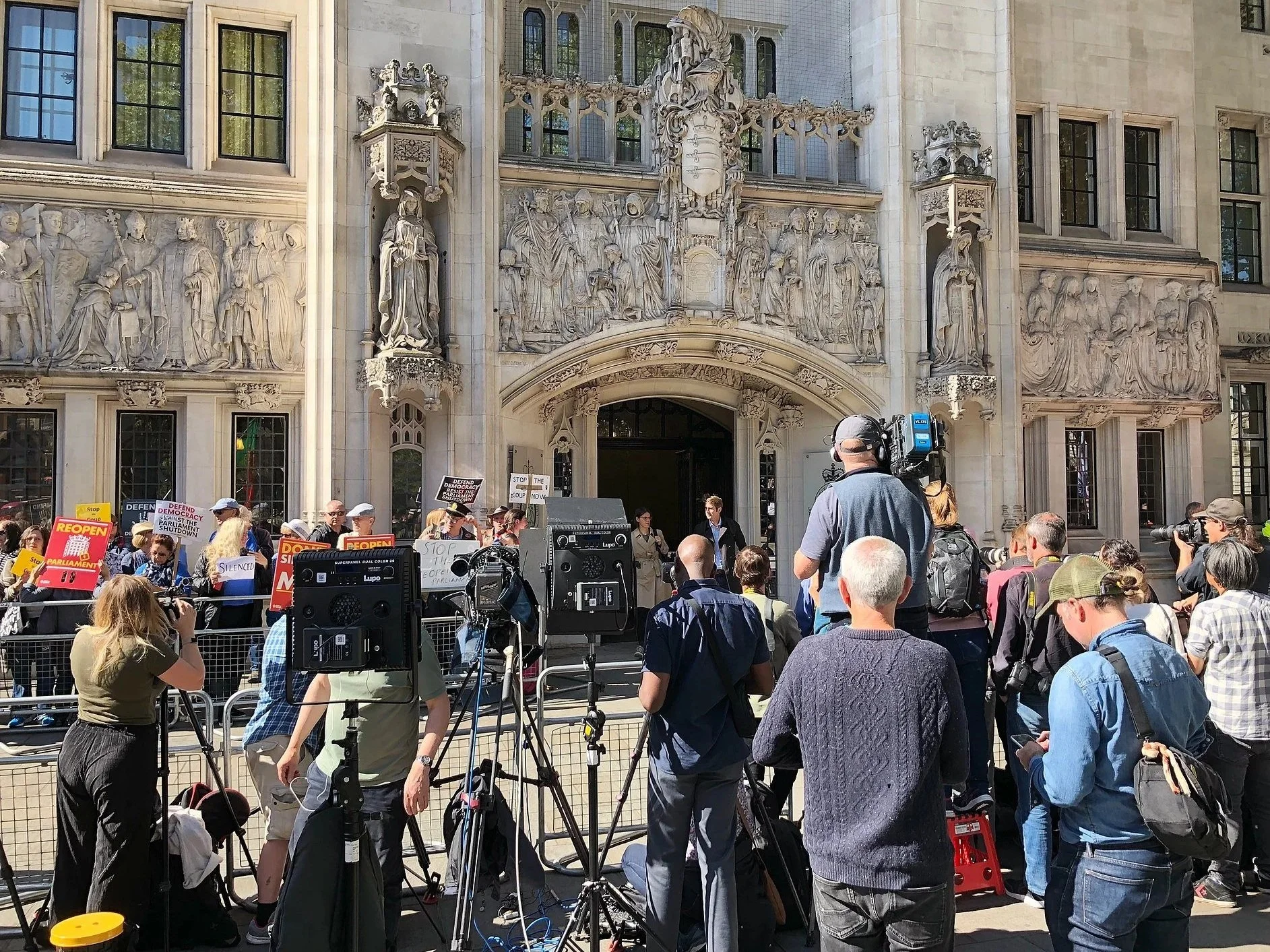
Image: Steve Nimmons, ‘Journalists assembled outside the Supreme Court in London as legal debates continue in case brought by Gina Miller challenging Boris Johnson's decision to prorogue UK Parliament’, Wikipedia Commons, Creative Commons Attribution 2.0 Generic.