
ICE and the Limits of Administrative Accountability
The legal authority exercised by U.S Immigration and Customs Enforcement (ICE) has come under renewed scrutiny as a result of the country’s expansion of immigration enforcement. The issue has sparked public debate, focusing largely on the human consequences of immigration detention and removal, with widespread criticism of prolonged detention, conditions of confinement, and access to legal remedies. While these concerns are significant, this article adopts a narrower focus. It examines ICE as an administrative body and asks a more fundamental legal question: to what extent is ICE’s enforcement power constrained by principles of administrative legality and accountability? Therefore, this article argues that ICE exemplifies a broader structural problem within US administrative law. The use of coercive executive authority with limited judicial and legislative oversight.
ICE within the Administrative State
ICE was established in 2003 as part of the reorganization of federal agencies under the Department of Homeland Security (DHS)[1]. With the authority to make arrests, detain people, and remove them, ICE operates as an enforcement agency at the nexus of civil administration and criminal-like coercion. However, unlike criminal law enforcement, immigration enforcement is formally categorized as civil in nature under the Immigration and Nationality Act (INA)[2]. This classification has profound legal consequences. It places immigration enforcement firmly within the administrative state and restricts the application of constitutional rights usually associated with criminal procedures.
Administrative agencies are ordinarily constrained by principles of legality, reasoned decision-making, and judicial review. However, immigration law has long been treated as exceptional. The “plenary power” doctrine, developed by the Supreme Court in Chae Chan Ping v United States[3], grants political branches with ‘broad authority to deal with foreign affairs and immigration’[4]. Although modern jurisprudence has softened the language of absolute deference, immigration enforcement remains an area where courts are often reluctant to intervene.
Judicial Deference and Limited Review
The scope of judicial oversight over ICE’s actions is significantly constrained by both doctrine and statute. In Reno v American-Arab Anti-Discrimination Committee[5], the Supreme Court emphasized the limited role of the judiciary in reviewing selective enforcement claims in immigration matters[6].
At the enforcement level, judicial review is further restricted by statutory provisions that limit courts’ jurisdiction. 8 U.S.C. § 1252(g)[7] of the INA contains multiple “jurisdiction-stripping” clauses, reducing the ability of individuals to challenge enforcement decisions in federal courts. In Jennings v Rodriguez[8], the Supreme Court rejected the argument that immigration detention statutes should be read to include implicit time limits, and instead authorized detention ‘without imposing a time limit’[9]. While the Court left open the possibility of constitutional challenges, the decision illustrates the judiciary’s hesitance to impose substantive constraints on the immigration enforcement framework.
Prosecutorial Discretion and Accountability Gaps
ICE’s authority is also characterized by broad prosecutorial discretion. Enforcement priorities are often set through internal memoranda rather than formal rulemaking, raising questions about transparency and accountability. Despite the wide discretion, ICE’s powers are constitutionally unbound, ‘the Fourth Amendment’s protections “against unreasonable searches and seizures”’[10], placing formal limits on its authority. However, regardless of these safeguards, the practical force is weakened by restricted avenues of judicial review as discussed earlier. Therefore constraining meaningful scrutiny of ICE’s practices.
ICE and the Normalization of Exceptional Power
The limited accountability of ICE must also be understood in its historical context. Immigration enforcement expanded significantly in the post-9/11 period, as ‘connection between immigration and law enforcement intensified’[11]. What began as an exceptional response has increasingly become a permanent feature of governance. Although immigration law is not the only area where emergency-style powers have become commonplace, ICE offers a particularly striking illustration of how extraordinary authority might continue without appropriate accountability measures.
From an administrative law perspective, this raises concerns about democratic accountability. Mashaw’s theory of due process within the administrative state highlights the importance of procedural safeguards, and further stating that ‘governmental action follows from identifiable public policies and legitimate processes for making them and not from the exercise of the personal will of government’[12] Where such safeguards are weakened, legality risks becoming a matter of executive discretion rather than legal principle.
In conclusion, this article has argued that ICE exposes a deeper structural weakness in the US administrative law. The difficulty of constraining executive enforcement power in areas treated as exceptional. Human rights advocates have long criticized immigration enforcement, but the more foundational issue is the weak measures of administrative accountability. Together, jurisdictional limitations, judicial deference, and broad discretion allow enforcement actions to operate outside the bounds of standard law. Thus, reform necessitates a renewed commitment to fundamental administrative law norms, such as transparency and reasoned decision-making. All of which are essential to the legitimacy of the state itself.
Bibliography
[2] What ICE Does and Why It Matters - U.S. Immigration and Customs Enforcement Explained
[3] (1889)
[4] Chinese Exclusion Case—Chae Chan Ping v. United States | Constitution Center
[5] (1999)
[6] RENO V. AMERICAN-ARAB ANTI-DISCRIMINATIONCOMM.
[7] United States Code: Title 8
[8] (2018)
[9] Jennings v. Rodriguez | 583 U.S. ___ (2018) | Justia U.S. Supreme Court Center
[10] Hillel R. Smith, The Fourth Amendment in the Immigration Context, Congressional Research Service (2019).
[11] How the 9/11 terrorist attacks shaped ICE’s immigration strategy
[12] Review: Jumping: Mashaw on "Due Process in the Administrative State" on JSTOR
Image Credits
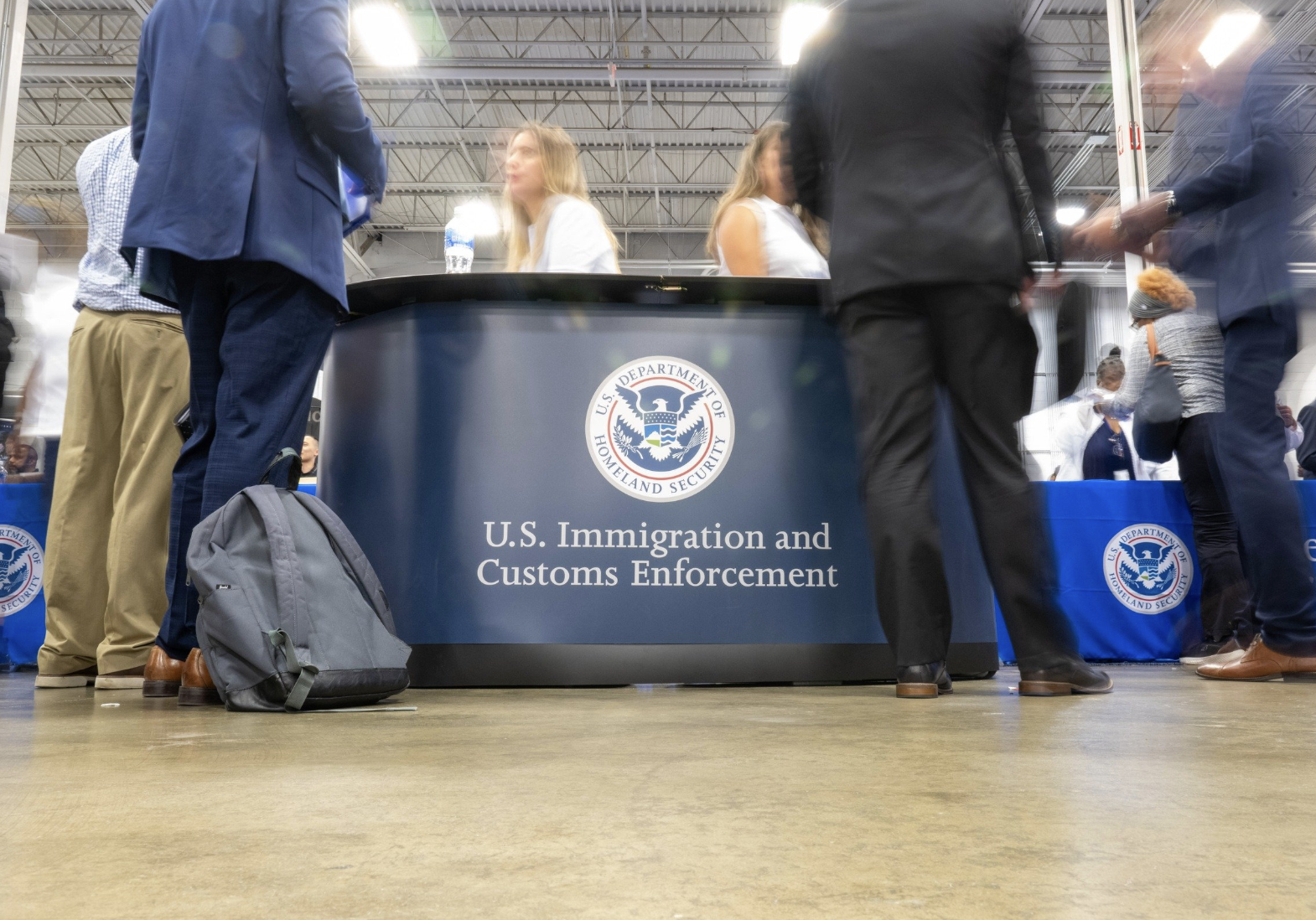
usicegov on Wikimedia Commons <https://commons.wikimedia.org/wiki/File:U.S._Immigration_and_Customs_Enforcement_(ICE)_Enforcement_and_Removal_Operations'_(ERO)_recruiters_speak_to_prospective_job_seekers_at_the_DHS_Career_Expo_in_Chantilly_Virginia_on_June_27,_2024_-_5.jpg>


_Enforcement_and_Removal_Operations%27_(ERO)_recruiters_speak_to_prospective_job_seekers_at_the_DHS_Career_Expo_in_Chantilly_Virginia_on_June_27,_2024_-_5.jpg)